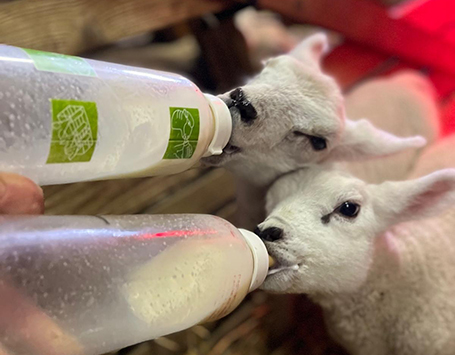
Rise and shine, its periparturient time…
Its official, spring has sprung as we see the daffodils and snow drops raise their pleasing gold and white faces above the green (albeit wet) grass around us.


Its official, spring has sprung as we see the daffodils and snow drops raise their pleasing gold and white faces above the green (albeit wet) grass around us.
Haemonchus contortus is a roundworm of significance in small ruminants, especially sheep. In fact, scientists at the Moredun Research foundation have referred to Haemonchus as the most important roundworm in sheep and goats in the world.
Faecal egg counts in horses are one of the corner stones of effective parasite control programmes and when used routinely give valuable information and allow informed decision making.
Nematodirus battus infection is a cause of severe parasitic disease in lambs each year, causing high mortality and morbidity with significant threats to welfare and considerable economic losses.
Historically, diagnostic testing has always been done in a medical laboratory. The lengthy process involves sending specimens away from the point of care to a laboratory, where a pathologist analyses the specimen. The results from this system can take 48 hours or longer.
Parasitology is the study of the biology of parasites and parasitic diseases. This scientific discipline encompasses studying the distribution, biochemistry, physiology, molecular biology, ecology, evolution and clinical aspects of parasites, including the host response to these agents.
If you’re a veterinarian, you will be overly familiar with intestinal parasite infections, and the current laboratory method for identifying them in animals. Diagnosis of intestinal parasite infections involves the identification of the eggs or cysts of the various parasite species in the faeces of the respective host. Due to the prevalence of parasitic infections in both companion animals and grazing animals, faecal egg testing is one of the most common laboratory tests for animals.
According to Pets in Australia: A national survey of pets and people there are almost 29 million pets in Australia today – more than the estimated human population of 25 million. With three in five households owning a pet, Australia has one of the highest pet ownership rates in the world. This says a lot about Australians’ relationship with pets, and the value they place on having a pet in the household.
Pathology is the medical specialty concerned with the study of blood, urine, and tissue samples to diagnose disease in the body. It has existed in some form or another since the times of Ancient Egypt, as far back as 1500BC.
Digital pathology images create immense quantities of data sourced from databases brimming with healthcare and research findings. This volume of data can be overwhelming and time-consuming for pathologists and scientists to analyse.
ISO 13485 Accredited manufacturing facility
VETQAS Approved
Telenostic Limited
Unit 71-72, Hebron Industrial Estate
Hebron Road,
Kilkenny
R95 CRK2
Ireland.


